Part 4: Goosehead: Insurance Agency Built for Growth
The information in this document reflects the author’s personal opinions and is for informational and educational purposes only. It is not investment advice, a recommendation, or an offer or solicitation to buy or sell any security. The author may hold a position in the securities discussed and may transact in them at any time without notice. Information has been obtained from sources believed to be reliable but is not guaranteed to be accurate or complete. Readers should conduct their own research and consult their own financial, tax, and legal advisors before making any investment decision. This document contains forward-looking statements, estimates, projections, and opinions that involve significant assumptions, risks, and uncertainties. Actual results may differ materially. Past performance is not indicative of future results, and no assurance can be given that any investment thesis discussed will be realized.
None of the writing that follows was written with AI. Certain charts were created with the help of AI.
Contents
- Opportunity overview: Goosehead Insurance (Nasdaq:GSHD)
- GSHD Business Overview
- Why own a personal lines insurance distribution business?
- Relevant industry dynamics
- Market size and growth
- Market structure: shifting distribution trends
- Robinsons are the coveted customers in personal lines P&C and they all have HO
- Long-term structural tailwind for HO: SCS and wildfire exposure growth driving rate repricing
- Short-term tailwind for personal lines premium growth: softening market
- GSHD’s competitive advantages provide win-win-win value to the ecosystem
- Learnings from talking with 15+ GSHD agency owners
- The high PIF sales velocity potential was validated, but not when the playbook isn’t followed
- Directive to focus on growth has been a significant sentiment shift in the last year
- The performance of the service function has mixed reviews
- The tech platform has positive reviews
- M&A is active within the franchise system
- Why is this opportunity available?
- Catalysts and tailwinds
- Considering opposing viewpoints
- Competition
- Governance and capital allocation
- Valuation
- Hypothesis monitorables (ranked by relative importance)
Opportunity overview: Goosehead Insurance (Nasdaq:GSHD)
$000s except per share data
The quick pitch
- Goosehead is a high-powered sales organization that happens to sell personal home and auto insurance
- If you own a home or drive a car, you must have insurance. This is unlikely to change, and the climate and overall risk environment is getting more risky, not less risky
- As someone buying insurance, it’s better to have choices of coverages and price, while receiving ongoing advice from someone who doesn’t represent the insurer selling you its product
- Goosehead sells insurance with this choice model, so it is better for the consumer, and it has a better sales mousetrap, making Goosehead valuable to its selling agents and its carrier partners
- Homeowner’s insurance (HO) is complex enough to make human agent advice desired over an AI-only experience
- HO is the most valuable insurance policy to insurers/carriers, and there are several tailwinds for HO that will support long-term sales volume
- Goosehead’s stock became out of favor because of AI-driven fears of insurance agents being less relevant, but this tech-driven disruption narrative is not new to the industry. The industry has shown at least twice before that agents are here to stay
- The business is strong today, and has a reliable mechanic that sets a floor of around 10% annual revenue growth
- Goosehead has been taking share from its competitors, even in the hard market; it has grown its premium by 1.7x of its two closest peers combined since 2021, the beginning of the hard market
Hypothesis summary
Goosehead is one of the largest independent personal lines insurance agencies in the US with ~$4.5B of written premium and 2.0 million policies in force (PIF). It sells choice and speed for a product that consumers must buy, and it competes in an industry that has been slow to evolve the buyer experience and selling agent experience.
The business generated after-tax returns of 150% on its capital invested over the last five years (cumulative after-tax operating profit over the last 5 years compared to total investment over the same period) and over 50% after-tax on total assets. This is in part because a book of insurance is a self-compounding asset that takes minimal capital to grow and in part due to the high-margin royalties generated from an asset-light franchisor model.
Several clouds have created an opportunity to own this business at a price comfortably below its intrinsic value for the first time since it became a public company in 2018:
- AI-driven fear narrative that insurance distribution will be disintermediated because AI will be able to sell insurance, making agencies less relevant
- Revenue growth slowing from the lofty levels the business generated since its IPO, making it appear a victim of its own success for the first time and losing the allure of its high-octane growth
- Historically severe hard insurance market, which has persisted for four years through 2025; the market has only begun to soften in recent months
- Despite the recent selloffs, the stock is not “optically cheap” based on near-term multiples
The driver of the growth slowdown has been a hard insurance market, not a deterioration in business performance. GSHD took share during this period. The insurance market has only recently begun to soften, with near-term transition to a soft market providing a tailwind to growth.
At $35 per share, the market is pricing an 11.5% return based on a 15-year revenue and FCF growth CAGR of ~9% and ~10%, respectively, with modest operating leverage achievement (23% EBIT in 2030, 28% EBIT in 2036). This is a below-consensus outcome by 15-20% in the next few years, a scenario that is punitive based on the current growth of the business.
My base case shows a 15-yr revenue CAGR north of 15%, still a large margin below management’s 30% premium growth target, and FCF growth of 18% over the same period (off of 2025’s base, which is at the tail-end of a prolonged hard insurance market and burdened by the initial Digital Agent investments). Notably, unlike broader insurance brokerage peers, GSHD grows virtually 100% organically.
A core part of my thesis is that I suspect the market undervalues the mechanical thrust of the renewal book, primarily driven by the franchise business (over 80% of productive capacity). The renewal book, by itself, should generate ~12-13% annual revenue growth over the next five years assuming even meager new business generation.
This is an opportunity to own a great business at a price that assumes growth comes well below what the business is reliably capable of generating. The business has natural operating leverage from both its higher-margin renewal book and its high-margin franchisor model, though the base case assumes an achievement of a reasonable 30% EBIT margin 10 years from now which approximates today’s margin for the leading, M&A-heavy commercial insurance brokerage peers. Outperformance of the base case on margin growth alone is a setup for highly attractive returns.
I estimate this to be a 17-20%+ IRR opportunity, with fair value in the $80-$100 per share range.
GSHD Business Overview
- Largest personal lines insurance independent agency (IA) in the US selling HO and auto with $4.5B written premium (Top 2 IA in personal lines focus, Top 5 in IAs that sell personal lines); personal lines industry is $530B premium of which ~$200B is sold by independent agencies
- Over 200 carrier relationships (including largest writers of personal lines, Progressive and GEICO) built over ~23 years in business
- 2.0 million policies in force, representing a >20% CAGR the last 5 years during a historically hard market
- Premium book over-indexes to HO with 63% of premiums, auto is 34% of premiums; nearly 2.0 million policies in force (PIF)
- Sells through its own Corporate sales agents (18% of premium, 482 producers, 16 offices in 11 states) and Franchises (82% of premium, 2,113 producers, ~1,000 locations in 43 states covering 97% of population)
- Franchise business (GSHD is franchisor) provides high-margin royalty stream (20% on new business commissions, 50% on renewal commissions)
- Core go-to-market strategy is leading with HO by building relationships with centers of influence in home buying – real estate agents and mortgage professionals (Referral Partners or RPs)
- More energy-, time-, and cost-effective than advertising or buying leads
- RPs provide highly actionable opportunities via live home buying transactions which leads to bind rates in the 40-50% area compared to sub-20% industrywide
- Newer channel and go-to-market strategy is Enterprise, which seeks partnerships with companies selling adjacent services, like financial institutions, mortgage servicers, real estate brokerages, home-service platforms; addresses emerging embedded insurance trend
- Sales and service functions are separated, differing from industry norms
- Optimizes new business growth; GSHD agents are over 2x as productive as industry average
- Centralizes and scales variable and fixed service infrastructure across all policies; service payroll ~75% lower than industry best practice as % of sales
- Selling model optimizes for higher long-term growth of profit dollars over margin percentage
- Focus on new business sales choice of coverage and price and speed higher bind rate more and faster PIF growth larger renewal book low service burden focus on sales
- At corporate and system level, company invests in producers and technology to enhance sales and service; North Star is PIF growth and higher retention (same as carriers but without the highly complex game of underwriting)
- At franchisee/agency level, renewal commission paid to GSHD is significant “OpEx,” but very high ceilings on sales volume and renewal book size incentivize growth to maximize profit dollars
- Renewal commissions are higher margin than new business commissions, and over time, most of the book becomes concentrated in renewal commissions
- Growth strategy is simple and has a long runway in the US: penetrate geographically and transactionally by growing agent force, accessing more points of home insurance origination (Enterprise)
- Culture of investing in proprietary technology to support new business generation and service
- Unified agent sales and service platform built with proprietary tools on top of Salesforce
- Internally developed an internal quote rater (Aviator)
- Internally developed a consumer facing app (Digital Agent)
- Have been applying AI throughout its tech for nearly a decade (referenced in the 2018 IPO prospectus)
- Founded in 2003, started franchise business in 2012, went public in 2018, reached $1B TWP in 2020, $4B TWP in 2025
Why own a personal lines insurance distribution business?
A book of insurance business is a self-compounding asset. 9 out of 10 dollars renew every year at low cost. Replacing one dollar of churn and adding additional new policies to the pile every year is a more-than-achievable task. Then 9 out of 10 dollars of that bigger pile renews the next year, and so on. New business generation usually comfortably exceeds churn.
Consumers are required to buy insurance. Auto is mandated by state law if you have a car, and HO is required for a mortgage (or if you don’t have a mortgage, it’s required if you like good sleep). 50 years from now, consumers will be buying insurance on their cars and on their homes. For HO, the environment is getting riskier, so coverage gaps could close, and rate increases are likely to outpace inflation as these risks are appropriately priced. Auto premiums may go down over the long run due to structurally better safety, but the timing, magnitude and second order effects are all difficult to predict and are not material counterweights on this investment hypothesis given the price that is being offered by the market.
An agent’s book of insurance requires little to no capital to grow. Agents or producers sell new policies on behalf of the carriers or insurers to earn a commission. Producers take a majority of the agency’s commission dollars on the policy’s first year of premium. Then for each renewal year, the business takes the vast majority of commission dollars. Any capital outlay is the amount the business pays a producer before the producer pays for himself. This tends to happen quickly in personal lines insurance, where policy terms are usually one year or less. This means it’s well under a year for a producer to start paying for himself.
Selling personal lines insurance is a simple business. The policies themselves vary in level of complexity, but the business is simple – sell as many policies as you can and retain them as best you can. Everything about the business revolves around this core motivation.
Relevant industry dynamics
Market size and growth
The personal lines P&C industry writes over a half trillion dollars of premium annually, and it has grown premium just over 6% annually in the last 10 years. The split among auto and home premium is about 70/30 today. With rising risks and exposure in home, and potentially long-term rising safety and declining losses in auto with self-driving cars (this is multi-decadal), I expect home to take more industry share over time.
US$ in billions. Source: GSHD 10-K. NAIC.
With respect to the total HO opportunity, about 100 million total single-family detached and attached houses comprise the stock in the US. Several methods of estimating total HO policies in force on these homes triangulate around 80 million, factoring in the uninsured penetration of the homes that do not have mortgages.
The 15-year average of existing home sales is about 5 million per year, but in 2025 this was 4 million, so the current pace is about 20% below the 15-year average. The consensus view is that there’s a housing shortage in the mid-single digit millions of homes in the US that would take at least a decade to correct, because the pace of new construction, which is 550k-600k annually the last 15 years (depressed versus 1M+ pre-GFC), needs to eat into the shortage/gap while also absorbing new household formation every year. More household formation and housing transactions are a tailwind for HO insurance.
High interest rates, though, have created affordability issues for new buyers and a lock-in effect for homeowners who don’t want to give up their low rate by moving into a new home, holding housing inventory low. A lowering of interest rates is a clear catalyst for housing transactions.
Market structure: shifting distribution trends
There are three basic ways that personal lines insurance is sold:
- Direct from the carrier: Progressive and GEICO are most prevalent in direct in auto. Consumers go online to Progressive or GEICO’s website to buy a policy directly.
- Captive agent: State Farm pioneered the captive model. Consumers buy policies from their local State Farm agent, who sells only State Farm policies. Certain other insurers use the captive model, the most prominent being Allstate and Farmer’s. HO seems to be relatively concentrated in Captives.
- Independent agent: An independent agent offers policies from multiple carriers with which he/she is appointed. Carriers must appoint licensed, independent agents who are effectively committed to bringing quality clients to the insurers; not anyone can just call up Progressive and start selling insurance.
Only IAs offer a choice model; Direct and Captive provide the buyer with one choice because they are offered from a single carrier.
Both the carrier side (Direct and Captive) and the distribution side (IAs) are fragmented.
Diversity on the carrier side provides to the market a diversity and availability of competitive insurance product and virtually eliminates the risk that any one carrier’s failure would hurt a wide swath of consumers/insureds with unfunded claims.
Diversity on the distribution side provides a long-term opportunity for scale advantages to companies like GSHD. There are about 39,000 independent P&C agencies in the US (this includes those selling commercial insurance), with 76% of agencies classified as “small or medium” according to Big I. Many of these will not be able to effectively compete in perpetuity.
Carriers utilizing the IA channel for distribution will increasingly prefer working with a small handful of scaled, institutional-grade distribution partners versus a long tail of very small, mom-and-pop operated outfits. For IAs, it sets up a clear long-term incentive and opportunity for growth. Indeed, this structural shift has been playing out for a while now in commercial, and it’s in the earlier stages in personal lines.
This depicts the most impactful structural dynamic in the personal lines industry, in my view. In the last 10 years, the way personal lines insurance is bought has been changing significantly.
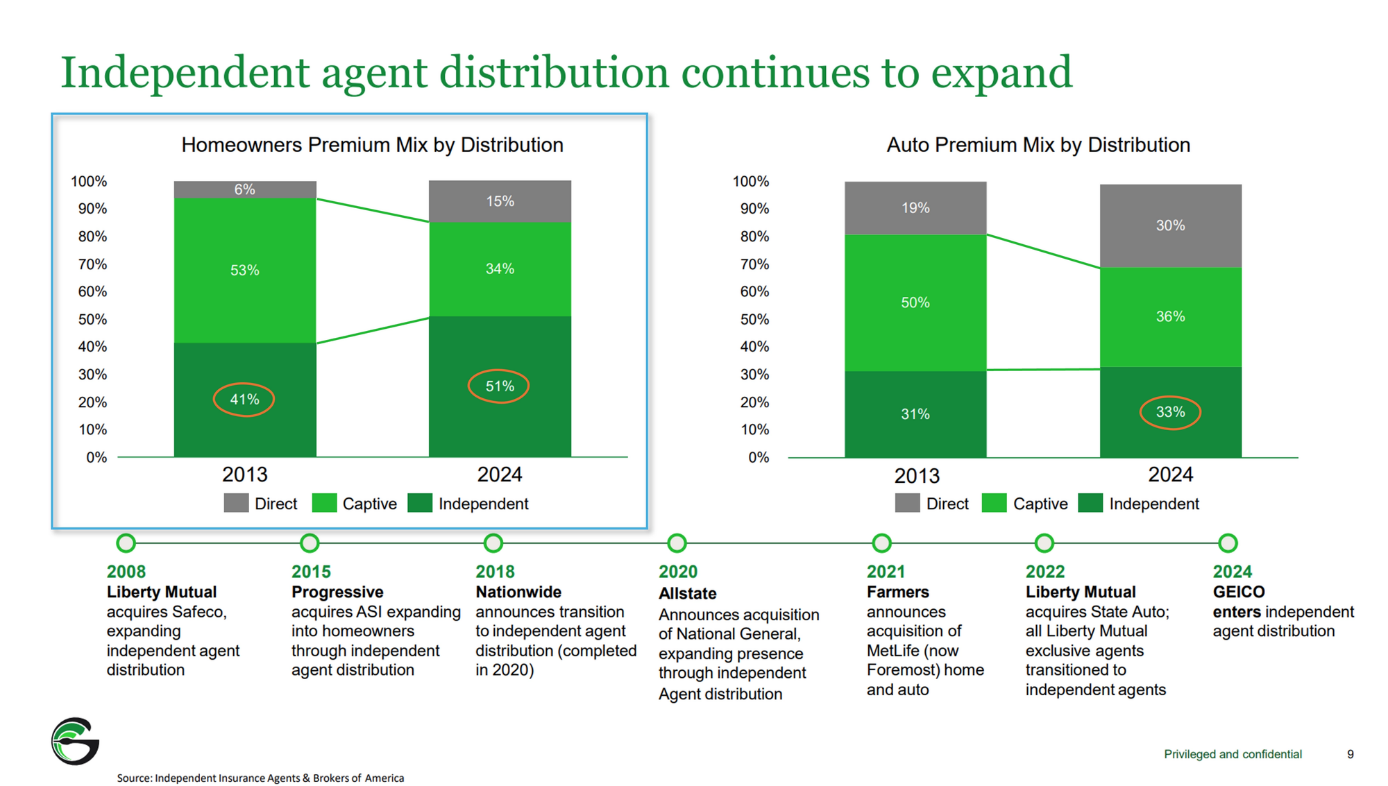
Source: GSHD Investor Presentation, March 2026.
Within home:
- Captive has shed nearly 40% of its share — 19 points of share — to the Direct and IA channels
- Direct has picked up 9 of those points. This is arguably attributable to the general trend of more consumer transactions moving online, similar to the physical retail → ecommerce trend. Consumers have become increasingly comfortable buying online or on their phones
- Independent has picked up 10 of those points. This is arguably attributable to a better consumer experience that is the choice model coupled with a knowledgeable expert, supported by tech-enabled tools
- Direct insurers have increasingly moved into the independent channel to broaden their customer acquisition funnel. These include the largest carriers, with the most notable moves listed at the bottom of slide above: Liberty Mutual, Progressive, Nationwide, Allstate, Farmers, and most recently, GEICO. GEICO has over decades touted the low-cost competitive advantage of writing auto insurance direct, but I believe it came to the realization that to be competitive in winning share and competing with Progressive, it needed to open itself to the agency channel to access consumers who are increasingly looking for choice and who tend to be bundlers with more assets
Why is HO a product that’s more suited for the independent agency channel than auto?
- Product complexity. Insuring a home is relatively more complex than an auto, often requiring 100-300+ data points. There is also a wider variety of relevant coverage options. This means that obtaining and understanding a HO policy is more difficult than for autos
- Pricing variability. Quotes for home insurance can vary by thousands of dollars, making independent agent advice more valuable
- Value of asset. Homes are often the most valuable asset in a consumer’s net worth, multiples of their cars, so adequate protection is more important
- Risk matching for carriers. Locality and risk varies widely for home versus auto, and independent agents with local expertise and customer access provide value to carriers looking for or avoiding specific risk profiles. Agencies act as demand curators for carriers, in a more efficiently decentralized way than the carriers could do on their own
Robinsons are the coveted customers in personal lines P&C and they all have HO
“Robinsons” are customers who bundle HO with auto and potentially other ancillary personal lines from the same carrier. To be a Robinson, by definition you have a HO policy.
They are coveted because they are the most valuable:
- Highest premium dollars given multiple products
- Higher retention and therefore policy life expectancy, meaning they are stickier and generate significantly higher lifetime value
- 3x longer tenure than monoline auto customer (according to Progressive)
- 45% of Robinsons have been with their insurer for 11+ years (JD Power 2022 Study); retention is ~95% compared to ~85% non-bundled HO
- 53% of Robinsons intend to renew with their current insurer (Insurance Journal)
- 41% of Robinsons choose insurer specifically to bundle (JD Power)
According to 2021 data from Progressive, Robinsons are just over 50% of the personal lines industry premium. Of the Robinsons, Captive has a 50% share, IA has a 30% share and Direct has a 20% share. Most of the Robinsons sit with the Captive channel because they became customers over a decade ago, and haven’t had a catalyst to leave. It is reasonable to believe that much of the share shift away from Captives into IA and into Direct has disproportionately taken place away from Robinsons to date.
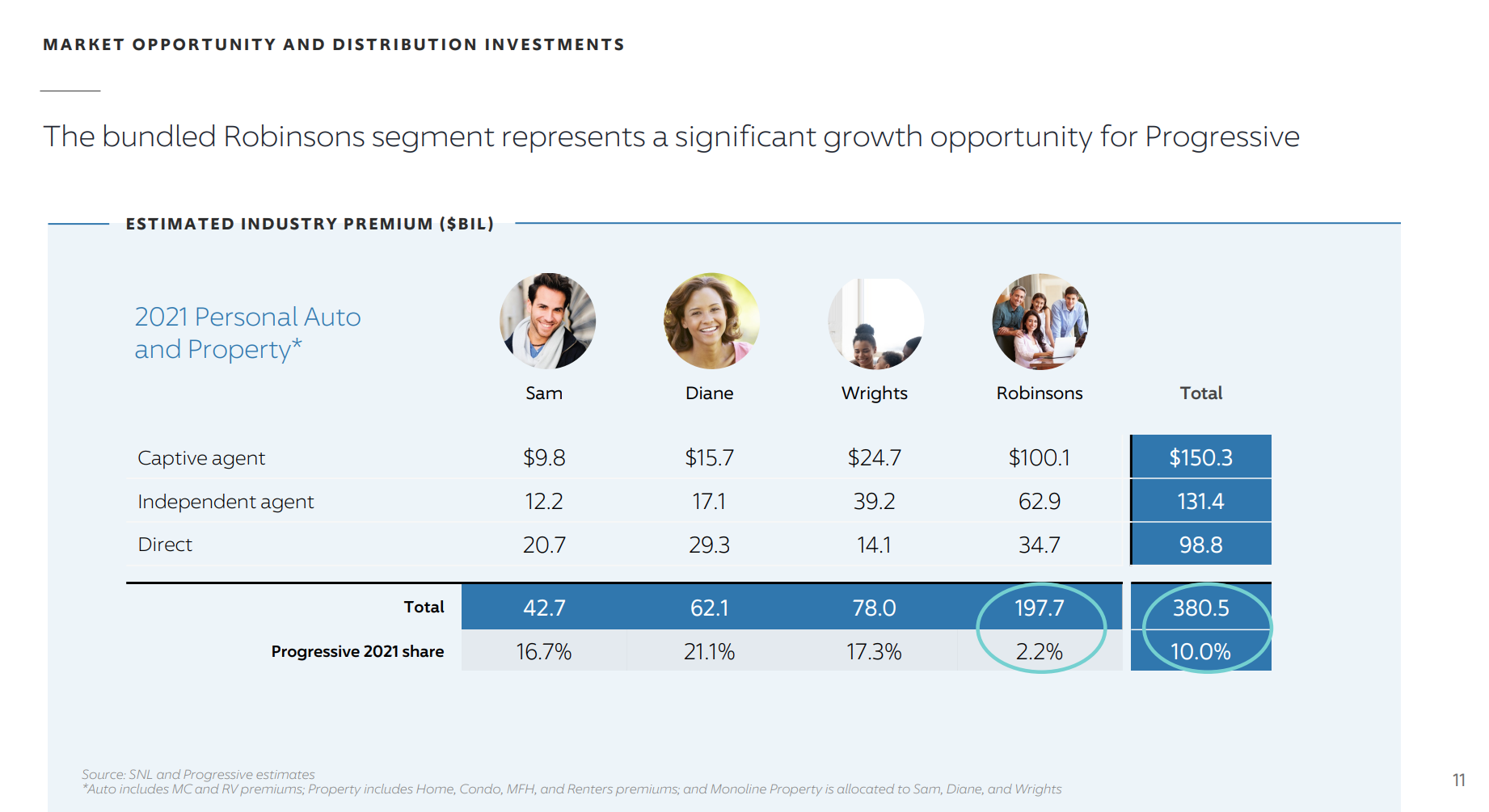
However, as new, younger Robinsons are slowly created, and/or as existing Robinsons have catalysts to think about switching, the coveted Robinsons are more likely to move away from the Captive channel.
Shopping activity is usually higher in a hard market, especially at the tail end of a hard market (2025 through now), because rates have risen. This includes the Robinsons, who have also been up for grabs – JD Power’s 2025 HO Study found that now 45% of multi-policy customers did not plan to renew, which is lower than the 53% baseline noted above (caveat that consumer intent, particularly in a survey, is not indicative of final behavior; also from two different sources). In the May 2026 annual meeting, GEICO-owner Berkshire Hathaway CEO Greg Abel also highlighted the recent increased shopping activity in the industry.
As more Robinsons retreat from the Captives, it seems likely they could disproportionately migrate to the IA channel, because the IA channel gives them the best chance of finding their best bundled carrier. It also could be likely that as more Robinsons enter the IA channel and develop a relationship with their agency, they will stay with that agency because the choice model is structurally advantaged for the customer to shop and find the best available bundled carrier in any given year.
Long-term structural tailwind for HO: SCS and wildfire exposure growth driving rate repricing
The single-biggest exposure growth category in US personal property is SCS (severe convective storms, producing hail, wind, and/or tornadoes). As of 2024, according to Munich Re, the 5-year annual insured loss from SCS was $2.5B in the early 1980s, but the last three years have produced insured losses north of $50B annually. This is a 20x increase. SCS is no longer a “secondary peril,” it is now a primary peril.
Wildfires are also responsible for an increasing share of insured losses. The Palisades ($33B economic loss) and Eaton ($25B economic loss) fires in California in 2025 were the “costliest fires of the modern era” and were the top two loss events globally in 2025. For comparison, the infamous Paradise fire in 2018 had an economic loss of $17B in 2025 dollars.
The chart below tells this story; you see both the growth with SCS and wildfires, and you see that SCS is now the leading peril.
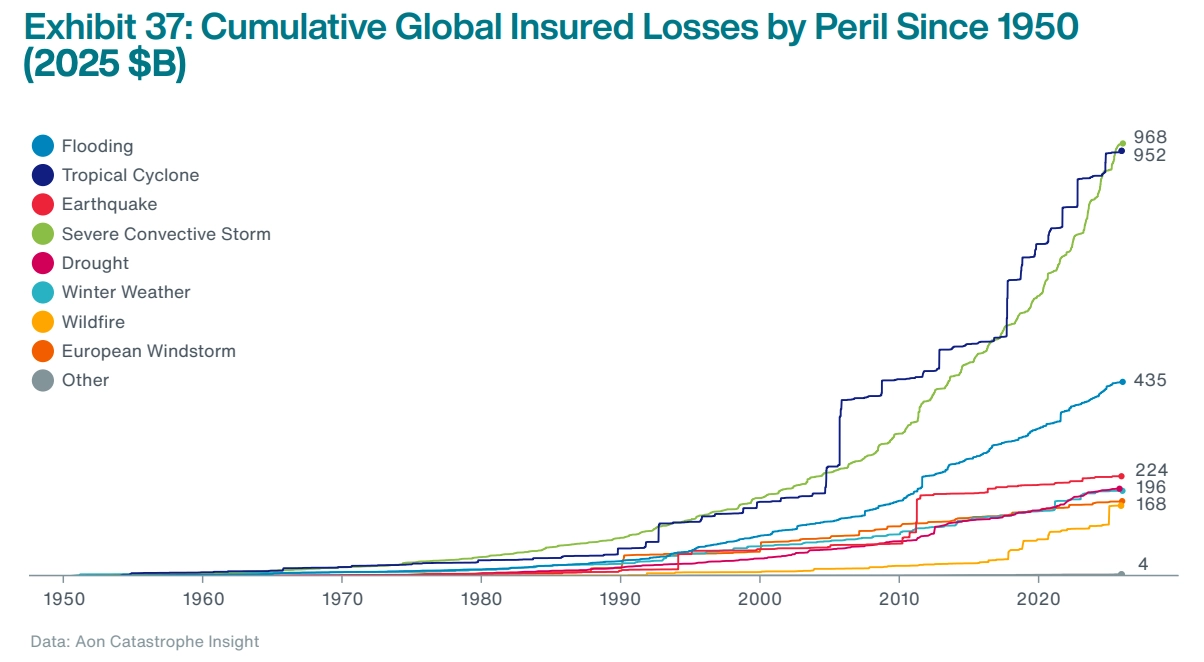
Source: Aon 2026 Climate and Catastrophe Insight report.
While climate change is a component of increasing losses from SCS, the primary driver is the increasing value of insured assets in harm’s way. This is driven by more people moving to vulnerable risk areas, and their wealth and home values rising. This altogether is referred to as exposure growth.
Swiss Re estimates that about 80% of the growth in insured SCS loss is attributable to exposure growth (below, construction cost in excess of general inflation plus population at risk plus economic growth). The residual component is where the climate risk component sits. The takeaway is that insured losses from SCS are growing at 7.0% absent of inflation, of which 5.6% is from exposure growth. This must be reflected in insurance premiums as carriers reprice for this risk.
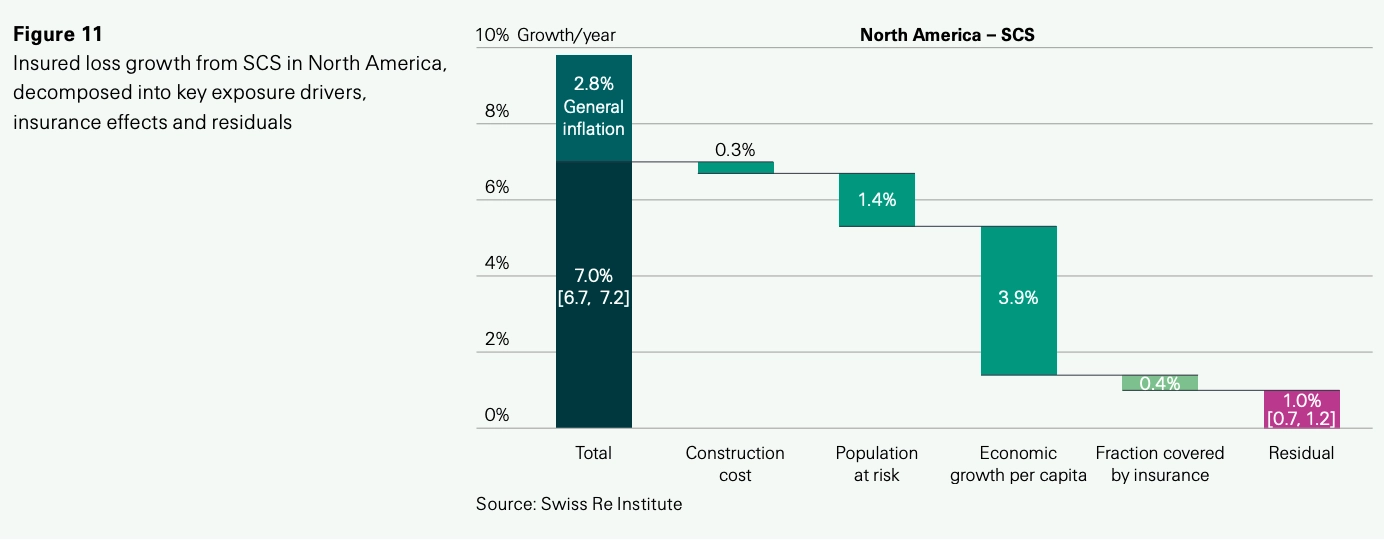
Source: 2026 Swiss Re Institute sigma report.
In contrast, the residual component for wildfires explains 60% of the non-inflation growth (compared to 20% for SCS), suggesting that underlying climate change drives most of the loss and rate repricing from wildfire risk.
Short-term tailwind for personal lines premium growth: softening market
In insurance, it’s important to understand whether the market is currently hardening or softening. Hardening refers to rising rates, associated with less insurer capital at work. Softening refers to decreasing rates, associated with an increasing abundance of capital.
It works as a cycle because hardening and softening each effectively cause the other. An abundance of capital, observed by insurers’ willingness to place policies and therefore creating ample supply, breeds competition, which drives down rates. When rates are driven lower to the extent that they are insufficient to cover losses from events like natural disasters, insurers start to become less profitable or unprofitable, do not earn attractive returns on capital, and capital therefore leaves the industry. This in turn leads to higher rates, insurers rebuilding reserves, and a lack of willingness by insurers to place new risk; in other words, a lack of supply leading to a hard market. When rates are driven higher relative to losses incurred, insurer profitability and returns on capital become attractive, so capital returns to the industry, initiating a soft market. This is the cycle.
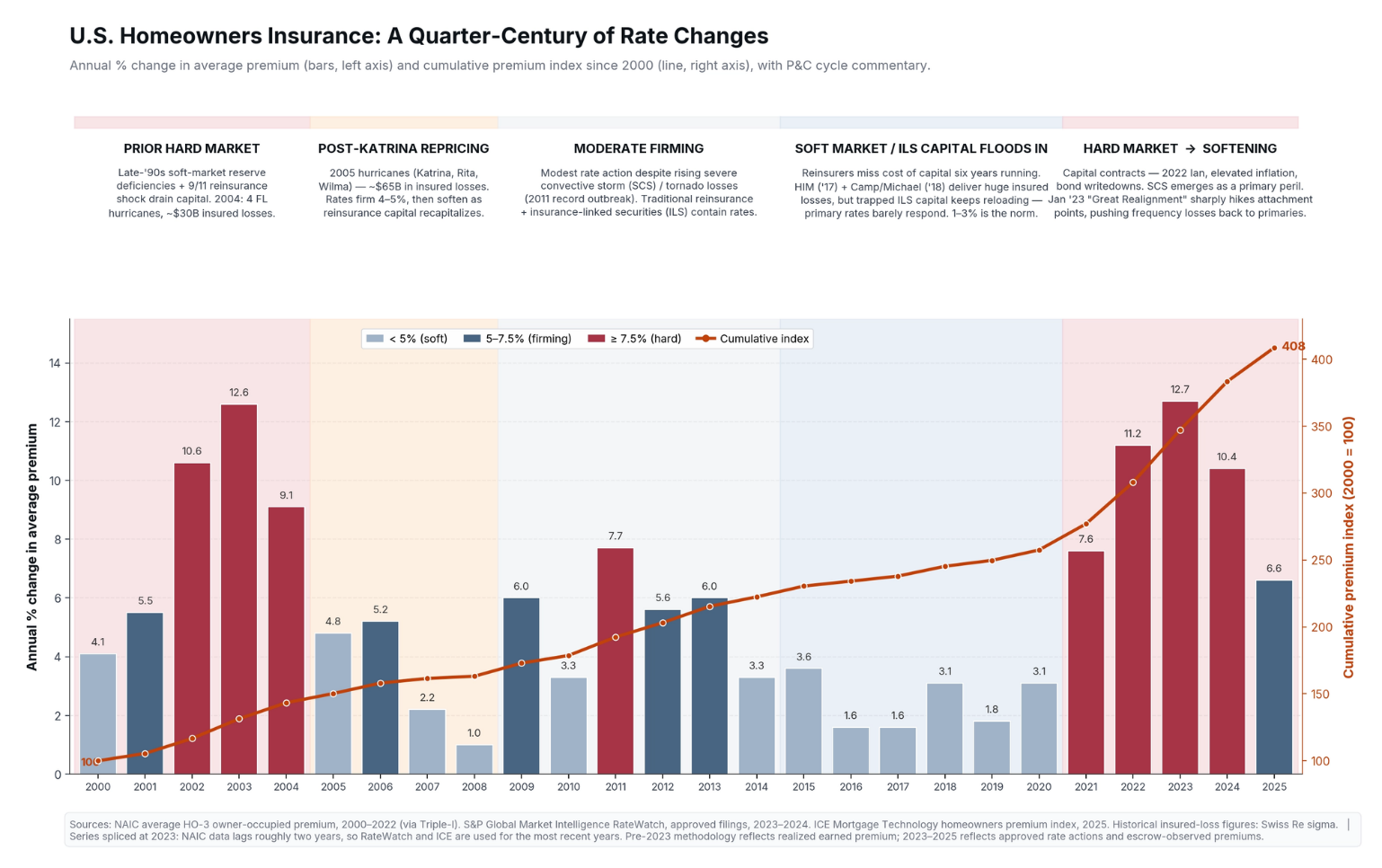
As the chart of the homeowners insurance rate cycle below depicts, 2021 through 2025 has been a hard market that’s historically acute (look at the slope of the line compared to the early 2000s hard market) and persistent (five years long). This was driven by a lengthy soft market from 2013 through 2020, and a variety of factors in 2021 through 2024: elevated inflation driving up replacement and repair costs of homes, higher interest rates driving losses on insurers’ bond assets, a slew of insured loss events including higher losses from SCS and structural repricing in the reinsurance market.
Easing started last year, which is expected to continue this year. This means homeowners’ premium rate increases will be moderating.
Note that according to the data depicted in the chart, there has not been a single year since 2000 where rates declined in homeowners (for comparison, this is not true for personal auto, where 2005 through 2009 showed rate declines in the 0.5% to 2.4% range).
GSHD’s competitive advantages provide win-win-win value to the ecosystem
Goosehead has two major competitive advantages: 1) a better, cheaper, faster mousetrap that is the closest thing to the way personal lines insurance ought to be bought; and 2) scale. Together, both would take years to replicate.
Superior insurance buying consumer experience – better, cheaper, faster
The two most important sources of value in buying personal lines insurance, especially for HO, are choice and speed. Consider a home buying transaction where a consumer needs to bind insurance during the home closing process.
Choice is important because it provides options for coverage and options for price. Homes are usually a consumer’s most valuable asset and the asset that’s most expensive to maintain and repair. Adequate insurance is important for most consumers’ budgets, and a lack of coverage could be financially consequential.
Price is probably more important. The obvious reason is that consumers want to manage their budget generally. But for a mortgage, the monthly cost against a buyer’s monthly income is a critical factor in the home price they can afford. People tend to shop at the higher end of their price range, leaving little margin for error. Insurance is part of this monthly cost, and if there’s a lack of price options on HO insurance, a high premium could bust the loan. So, being able to offer multiple carrier options and coverages to the consumer during this process provides value – it removes the take-it-or-leave it proposition one might face with a single option from one carrier.
Speed is important because home closings operate on tight timelines with multiple constituents and conditions. Real estate agents and loan officers do not get paid for deals that don’t close, so they have an incentive to ensure each workstream in the home closing process is completed accurately and quickly. Home insurance is one of these workstreams. Real estate agents and loan officers are therefore incentivized to recommend an insurance offering that is built for choice and speed. Choice + speed = reliability. This makes Goosehead an easy recommendation for RPs.
Superior insurance selling agent experience – better, cheaper, faster
The two keys to success for a personal lines insurance agency are 1) sell as many policies as possible and 2) retain more policies. In most insurance sales organizations, an agent has both of these jobs. Goosehead separates them. Sales is decentralized, and service is centralized.
I understand this through the lens of comparative advantage. Selling policies and servicing policies requires two different skill sets. Best-selling agents love selling and closing deals. They probably don’t like servicing, in part because their strong suits aren’t the ones best for service. This works the other way for those who are better fits for servicing. The whole is most productive when these domains are operated by their best-suited talent.
There also seems to be a compounding effect when an effective salesperson focuses only on selling. Top selling insurance agents follow a power law – the best are extremely productive. With premium retention rates around 90% in this industry, one hour of a top-selling agent’s time is worth much more than time spent on service.
Time spent away from building relationships and generating leads, or even constantly switching between them, has a non-linear cost. Why? Sales in an arena like personal lines insurance is a volume and velocity game. Lead flow begets lead flow, and deals beget deals. Market knowledge compounds. Trust and reliability compounds. Learning sales techniques and adapting them to the local ecosystem compounds. Interrupting this compounding kills growth that was there for the taking.
This separation also enables faster growth. For the franchised agents who effectively own their books, with this model, they can make more money. They make more money because the PIF ceiling, or book size, is higher. As an insurance book grows, more policies means more demand on the service function. Without the separation of sales and service, more time on service means less time on sales. This lowers the PIF ceiling. They also make more money in a shorter period of time. With 90%+ of the time spent on selling, PIF count grows more quickly, which means the passive profit engine of the renewal book ramps more quickly.
With the franchise model, the agency owners own the economics of their books. This is unlike most captive arrangements where agents have no economics or restrictive economics when they retire or choose to walk away.
Carriers also benefit from more efficient growth of a trusted distribution partner. Agencies are closest to the ultimate customer, the insured, and therefore know them best. Customer segmentation is highly important to carriers – segmentation is fundamental to underwriting risk. If a carrier wants to increase or decrease risk in a particular customer or insured segment, they must be able to identify and find those customers. Agencies already know where they are and directing them to the carriers seeking those insureds is a highly efficient way for the carriers to access the risks they seek or deploy new products they want to grow.
Scale: among largest personal lines focused agencies, largest in its HO bread-and-butter
With over $4B of total written premium, GSHD is a top 5 personal lines agency in the US, top 2 among those agencies with a predominant focus on personal lines, and the top agency selling more HO than auto. Like other industries’ distribution layer, scale matters in insurance distribution because it simplifies and compresses the counterparties the upstream seller needs to deal with and it provides a broader (better) and cheaper offering for the downstream end users.
For consumers, the value provided by GSHD is simple – the 97% of US consumers who have access to GSHD have access to choice. Scale has earned GSHD relationships with nearly all of the country’s most relevant insurers, which can then be offered to consumers as a panel of coverage and price options. More scale means more product to offer consumers. More product for consumers to choose from is better value. Independently owned agencies, or agencies that are smaller than GSHD, cannot offer as much choice because they are too small individually to matter to carriers and therefore will tend to have fewer carrier appointments. The 200+ carrier relationships and scaled and geographically diffused agent force would take many years to replicate.
For agents, the value provided by GSHD is also the breadth of carrier relationships. This provides an agent more product to sell consumers, which means the agent is more likely to appeal to more consumers and is more likely to close a sale with any given consumer (higher bind rate). More choice to be able to sell is better for the agent.
With scaled distribution players, carriers gain sophisticated partners that provide immediate access to and detailed knowledge of millions of potential insureds. Goosehead is relevant to all carriers. The alternative for carriers is to meet these potential insureds directly – through advertising – or through lead aggregators. Both of these are expensive and come without the sophistication of distribution partners.
Not to be understated, distribution partners like Goosehead also provide carriers with innovation on the technology shift that has been ongoing in the industry – an industry that, outside of Progressive, was arguably slow to adopt technology that improved service (e.g., direct/digital binding, digitally-native customer service tools, consumer apps, cloud migration vs. mainframe) and underwriting (e.g., telematics).
Customer stickiness a competitive advantage in progress?
As discussed earlier with Robinsons, once multi-line customers become customers of GSHD and become accustomed to the choice model, coupled with an easy user experience aided by technology, it may become more painful for them to leave GSHD. Or, it will at least make it harder to leave GSHD, because if they are already getting the best version of the choice model in the market, there would have to be a compelling reason to leave (such as a good deal and coverage from a carrier that is outside of GSHD, which is increasingly unlikely as GSHD scales). This goes not for just Robinsons, but for all customers.
Robinsons alone are not to be dismissed here. IAs like GSHD should be advantaged in commanding the most Robinson relationships over time, because IAs are the only ones that can offer choice of bundles. If IAs command disproportionate share of Robinsons, they will always be valuable to carriers looking to gain exposure to this coveted customer base.
This is in fact at the heart of Progressive’s current strategy. Discussing Robinsons on the Q1 2026 earnings call:
“[Our] focus on unlocking the Robinsons access, we’ll spend some time on in August. And for us, it represents a $40 billion to $50 billion top line opportunity. So we have roughly 20% share of Sams, Dianes, and Wrights and penetrating 40% of the $240 billion U.S. Personal Lines, Robinsons opportunity is just massive top line growth, and that’s why we’re focusing on it, but doing it in a smart way to ensure it’s deliberate, it’s consistent and most importantly, profitable growth that we generate from that segment.”
Learnings from talking with 15+ GSHD agency owners
Since late 2025, I’ve talked to over 15 Goosehead agency owners. These owners ranged from one year of tenure to 3+ years of tenure, 24 years of age to 50+ and 12 states (CO, OR, NV, MT, AZ, TX, WI, OH, MI, SC, ID).
These conversations validated the strength of the business model and provided texture to the growing pains the franchise business experienced after its initial wave of growth.
My observations and insights from these conversations are organized below. In hindsight, I grade myself with a C in the content covered, but the body of conversations together proved to be a worthy check on reality.
The high PIF sales velocity potential was validated, but not when the playbook isn’t followed
With the separation of sales and service, the GSHD model should show an ability to produce some astounding sales numbers, and it does. The overall record for one month’s sales was achieved in March 2026 by an agency owner in his early 20s, selling 240 new policies in 22 business days. Over 10 new bound policies per day is a huge number. At a captive agency, the bind rate might be 15% or less, which would imply that a captive agent would need to quote over 60 policies per day to bind the same 10. In an 8-hour workday, that would mean one quote every 8 minutes with no breaks. I think that would be impossible.
Outlier aside, the industry-leading productivity of the model also came through anecdotally in my conversations. I’m triangulating that the top performers are selling 2-3 policies per day, but this is a key figure to continue to validate as I continue to learn about the company.
Other observations on playbook execution:
- Several middle-aged owners who joined Goosehead after having been at captive carriers for a number of years told me that they grew their Goosehead book from $0 to the size of their old captive book in just a few years. ”Four years in, I’m making way more money with Goosehead than AAA” and “I was at AmFam for 16 years, my book is bigger now at Goosehead in less than 5 years.”
- The most common way the playbook is not followed is too much time spent on service. This is behavior that tended to transfer from owners’ prior experience at a captive. The solution to this, as told to me by owners who did not have growth issues, is setting expectations early with their clients that they are to use the service team for all service-related requests.
- The better performers tend to be younger and the ones struggling to produce at high volume tend to be older. This is consistent with the industry data – the average age of a P&C producer is high 40s / low 50s. Particularly in personal lines insurance, an industry that rewards speed and is becoming increasingly technology-pilled, younger producers will be increasingly better suited moving forward
Directive to focus on growth has been a significant sentiment shift in the last year
The majority of agency owners I talked to discussed an almost forceful directive from corporate for franchise agencies to focus on growing their books. In other words, they want each agency to reach the size where it makes sense to hire more producers (when the renewal commissions can fund new hires without need for incremental working capital), or if they are at that size, to hire more producers. If agencies don’t grow or are not focused on growth, the message was basically that they’ll be managed out of the system.
“The tone with Goosehead has really shifted, they want people to build mega agencies, ‘think big.’”
“Sentiment has changed tremendously over the past 6 months. They are prioritizing the bigger franchisees.”
In fact, this has been going on for a few years, management has talked about it, and it has played out in the total operating franchises number.
It may seem obvious to focus on growth at the franchise agency level, but in my view it’s an indication of the point in the system’s life cycle of growth. The franchise channel started in 2012, and since then, most of the growth has come from opening new franchises. Throughout the first wave, which was a decade or so, about three-fourths of new franchises were started by agents who left captive carriers. It was a land grab. COVID also provided a touch of gas to new franchise openings because opening an agency with little capital was an attractive proposition for entrepreneurial types with seemingly less stable full-time positions. Franchises reached a peak of 1,400 in Q2 2022 and is now back down to 1,000.
Over the last couple of years, and still today, the focus is on growing each agency versus growing the number of agencies.
On that front, corporate launched ASP (Agency Staffing Program), which is an in-house recruiting team that recruits producers for placement in franchise agencies. Agencies pay a small fee to cover the cost, and importantly, they receive valuable institutional know-how for hiring well. Hiring new producers with high success rates is a pain-point in the industry broadly, with Reagan reporting hiring success rates in the 30-50% range. The hire success rate I heard for ASP was higher, directionally around 80% or more.
Of the owners who talked about ASP (either they brought it up or I asked), there was unanimous support and positive reviews for the program. Many are using it for most of their hires. They find it valuable because it saves time that can be applied to selling.
The performance of the service function has mixed reviews
The most common point of dissatisfaction among owners was the reliability and quality of the service function.
Of those expressing dissatisfaction, it was because they were having to spend more time than they were told they’d have to spend servicing their clients. Centralized service is part of the pitch to franchisees.
Wait times (i.e., hold time on the phone) and simple errors were common issues raised.
Among those who experienced issues, some mentioned that the service function has been improving in the last year or so, and especially over a longer period of time. Some mentioned “newer leadership” working on improving the system and technology around service. There was also apparently a staffing shortage that management acknowledged and subsequently addressed.
A former captive agency owner told me that “even though service is flawed, it still takes a lot off my plate, and without them I’d be more bogged down.”
Other owners did not have much of an issue with service. These tended to be younger owners, owners of agencies that were growing quickly or owners of agencies that were larger. When I asked them whether they’d had issues with service, a common response was that it’s important to know how to use the service team and function well and to coach clients on how to use it well. Providing feedback to the service team on specific issues has also been constructive.
It’s also important to note the last few years have been a hard market, where clients are seeing rates rise significantly. This is an inherent and significant barrier to client satisfaction, so any issues with service may be magnified.
The tech platform has positive reviews
Many agency owners said the tech platform is one of the major positives of Goosehead relative to other models. No owner I talked to was dissatisfied with the tech.
The tech platform enables volume and speed because all of the tools agents need are incorporated into one system — data on referral partners, comparative rater, quoting, CRM. Agents don’t have to learn and have workflows across multiple tools and are able to do everything remotely from a laptop.
I don’t believe the tech is a significant competitive advantage, but it is an enabler of the model. Understanding more deeply what exactly is differentiated about the tech is an area I intend to cover. The ability to capture and leverage over two decades of customer and carrier transaction data may be where the thrust of the “tech” competitive advantage resides, particularly with AI improvement as an enhancement.
M&A is active within the franchise system
One of the ways that underperforming books, or books from owners who want to exit the system, are managed out is selling to existing franchisees. Several of the owners I talked to were either 1) open to eventually selling their book or knew of other small franchises looking to sell their books or 2) have purchased other books within Goosehead (and externally in one case).
A healthy M&A market is positive for the long-term growth of the system. For owners who have become less interested in growing their agency, selling their book means they can exit without simply handing over their book to corporate for nothing. Having a path to monetize their book if they wish to exit the system makes the franchise business healthier; otherwise, unmotivated owners might sit a while on their plateauing business.
It’s also a positive signal that there are willing buyers with the financial wherewithal to buy books and smaller agencies. In my conversations, it was also apparent that debt financing for these purchases is easily attainable. I spoke with a loan officer at Live Oak Bank who works on insurance agencies, and he told me that 90% of his Goosehead lending is for M&A.
As the largest agencies continue their growth, M&A will continue to be a lever they can pull to sop up the underperforming and smaller agencies to expand geographically. This is a net positive for the franchise channel, because larger agencies tend to have better per-producer productivity and greater longevity relative to smaller ones.
Why is this opportunity available?
There are several clouds around the business that have put pressure on the stock. At less than $40 per share, the stock trades at a three-year low and nearly 70% below its 3-year high.
Perception #1: AI-driven fear narrative that insurance agencies will be displaced by AI technology selling insurance
The narrative was sparked by the release of a few ChatGPT-linked tools in the second week of February. One was from Tuio, a startup insurance MGA in Spain, for HO insurance; and the other two were from Experian and Insurify for auto insurance. They all appear to be either a simple quoting app and/or a simple redirection tool to the companies’ normal quoting page. These three app launches, all within the same week, was enough to cause a selloff in insurance brokerage companies.
The nearly instantly infamous Citrini blog post also had a two-sentence reference to insurance distribution being disrupted.
Have we seen the movie of this narrative before? Indeed, when internet applications for consumer commerce was developing in the late 90s / early 2000s.
The conclusion of a 2003 academic paper “Insurance Distribution Channels: Markets in Transition” debunks the then-narrative:
Our analysis makes it clear that the early predictions of widespread adoption of the Internet as an insurance marketing channel were inaccurate. Insurers are using the Internet-led channel in a support rather than in a direct sales capacity. Also, the experience of online insurance brokers suggests that customers are less likely to sign up for insurance online, but instead use online sites to receive quotes from several insurers or to get identification cards and certificates of insurance quickly (Ha, 2003).
Given the disintermediation that has occurred in other industries (e.g., travel), the question then arises as why the insurance industry experience has been different. We suggest that perceived product complexity in part explains the very low levels sales of insurance products through the Internet- led channel. Some have suggested that airline tickets and insurance policies both are commodity types of purchases. As such, consumers would use price as the purchasing criteria. It seems clear that the complexities (perceived or actual) associated with the insurance contract make it a distinct type of purchase in the minds of many consumers. As noted earlier, product complexity also explains differences in adoption patterns between different types of insurance (e.g., higher adoption rates for personal auto insurance than for commercial insurance).
There are a couple questions that may be useful in thinking about whether AI will disrupt insurance brokers: 1) how has internet selling of auto insurance, the simplest of personal lines policies, played out since the early 2000s?; and 2) how might product complexity play a role in how insurance will be sold?
Progressive is an interesting case study because it was the first insurance carrier to offer online binding in 1997, has invested heavily in its direct and digital offering and is the largest writer of personal auto insurance in the US today. Below is a graph of its premiums written direct and through agencies.
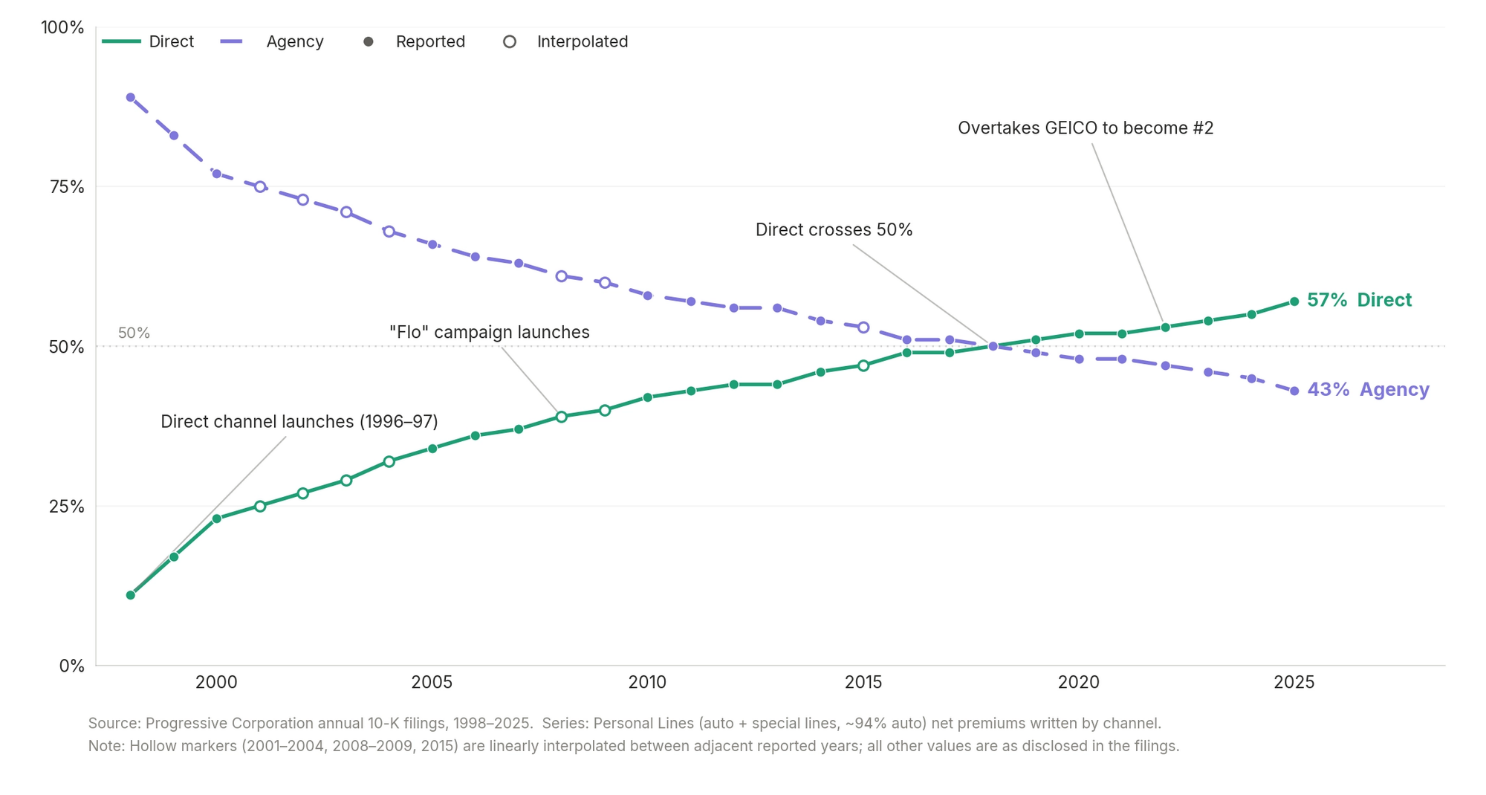
The takeaway is that even for a leading insurer that was a pioneer in the direct channel, it took 21 years (1997 to 2018) for direct to eclipse agency written premium. The growth of share to direct at the outset was larger and more of a step-function, but it has been a slower build since then.
Why has this been the case? There could be several reasons for the slower-than-perceived pace of direct binding adoption in auto policies, including:
- Insurance is one of the stickiest products consumers purchase, and annual catalysts for buying a new policy represent a fraction of total policies outstanding; consumers don’t often have a reason to change their policy
- It’s expensive for direct carriers to acquire direct customers, somewhere in the $1,000 per customer area today. TV advertising and buying leads are both expensive. Relative to the commission paid to an agency, which tends to have higher quality customers (more assets, more likely to bundle, lower risk), acquiring customers for the direct channel may not actually be much cheaper relative to lifetime customer value
- It takes a long time for consumers to change engrained buying behaviors; insurance policies were for a long time purchased via humans, and it is easier to leave a policy be and pay it every year on auto-renewal. If a policy was originally purchased via an agency, the renewals continue to go to the agency
- Some consumers want someone else, an agent, to do their insurance buying work for them. It is a service, just like having taxes done, going to a restaurant meal, having the house cleaned, etc.
- Insurers like Progressive don’t want to completely alienate their independent agency distribution channel, as doing so would terminate the relationship, albeit indirect, with a huge swath of its high-quality policyholders
- There’s perceived complexity by the consumer for an insurance policy, and they want to talk to someone who understands it
Outside of Progressive, looking at the entire industry, the JD Power insurance shopping survey for 2025 observes that 47% of consumers bind their auto policies online today. So, the industry has not yet reached the majority mark of online binding, 28 years after the first auto quote was bound online. 35% of consumers still purchase their auto policies with an independent agent today, with 53% doing so with a human (an independent agent or calling in to a carrier’s licensed agent).
A reasonable conclusion is that any change in how insurance is sold digitally may take much longer than is initially expected.
I also contemplate whether the internet has already done most of the lifting for selling insurance online. Does AI offer a new paradigm for how insurance can be sold? Or is it simply an enhancement feature that sits on top of the fundamental shift? The answers to these questions probably require nuanced, product-by-product thinking with a grounding in human behavior.
That leads into the next question, which is how might product complexity play a role in how insurance is sold? I agree with the authors of the 2003 paper – with HO insurance being more complex than auto, it should be less suited to unadvised purchasing.
As the 2003 study noted, that product complexity, perceived or actual, could be a primary reason that personal lines insurance maintains a presence with independent agents.
The complexity of an insurance policy, in basic terms, is driven by:
- the uniqueness of the risk
- the number of perils and coverages
- the correlation of risk
- risk data availability (higher frequency of losses means more data)
- loss tail length, and
- reinsurance integration.
An auto policy is fairly standard on all of these dimensions:
- the risks are fairly homogenous / not unique (a 2021 Tesla Model Y is a 2021 Tesla Model Y; whereas two homes in the same neighborhood could have dramatically different risk profiles despite common geography)
- the peril is vanilla because it’s collision-driven
- risk correlation is low (car accidents are independent events unlike a hurricane wiping out an entire area)
- data availability is high (lots of accidents every day), and it has increased with technology advancements like telematics
- tail length is low (the loss is known shortly after the accident), and
- there’s very little reinsurance integration (because risk correlation is low).
Auto insurance is basically commoditized, whereas home insurance is not. HO introduces more perils and variables and coverages that make each home a relatively more unique risk. These de-standardize and de-commoditize the insurance.
The more complex the insurance product, the more it ought to be sold with agent advice. This is common sense – the consumer is uninformed and a consumer doesn’t want to learn how to become an insurance agent himself. Nor does he want to spend the time with the data capture and entry, shopping around for quotes, and understanding differences in coverages for the many variables required for home insurance.
All of this is to suggest that because HO insurance is a relatively complex product compared to auto, it is less suited to an automated purchase process that an LLM may one day be able to handle. Even auto policies took 28 years to get to the ~50% mark for binding online.
People also tend to want someone else to handle their home insurance – it’s easier, faster and better. Just like people like to buy services of other things they could force themselves to do – their taxes, making a meal, cleaning their house, washing their car, etc.
There is also precedent for a phenomenon called Jevons Paradox, which is that when a technology makes a task or service more efficient, total consumption of that service increases because lower costs expand demand. Examples are radiologists, call centers and accounting/bookkeeping.
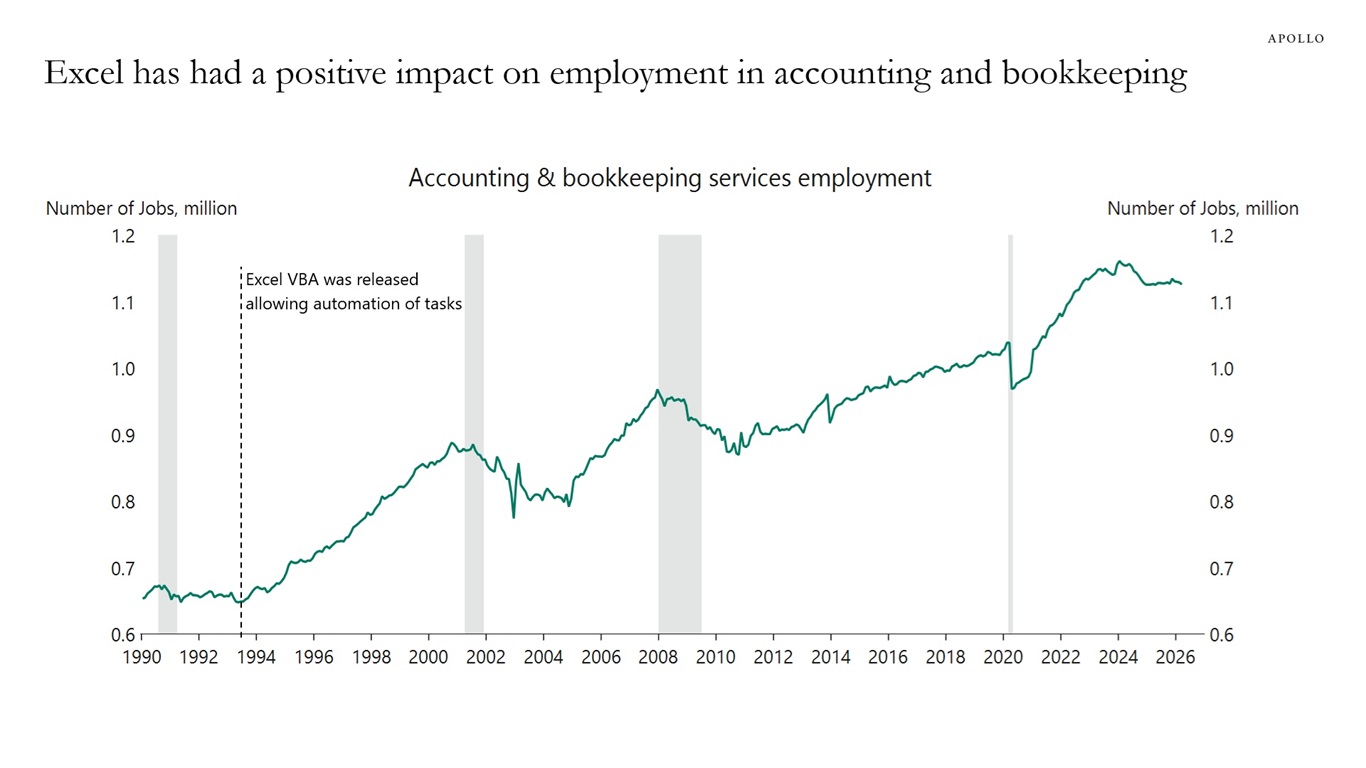
Sources: US Bureau of Labor Statistics (BLS), Macrobond, Apollo Chief Economist.
Perception #2: Written premium and revenue growth has slowed significantly relative to the first 5 years since IPO
Written premium growth was above 40% from 2018 through 2022, then cascaded down to 17% most recently in 2025. Revenue growth is a little more volatile but logically follows the same trajectory over a period of several years.
I attribute the slowing premium growth to an increasingly large base of policies, but mostly to the hard market in personal lines insurance that began in 2021 and persisted through the end of 2025. The market is starting to soften, and Goosehead’s PIF production seems to have bottomed and inflected in Q4 2025. Given year-over-year policy pricing trends in early 2026, I have confidence it has bottomed, and Goosehead has been steadily increasing YoY PIF growth since Q2 2024.
Goosehead’s double-digit PIF, which has been steadily growing since bottoming almost two years ago, despite a hard market that has been strong and persistent by historical standards, is a positive sign for the health of the business.
Perception #3: Double-digit revenue growth is not durable
I contend this perception is due to the market not appreciating the magnitude of the revenue growth floor that comes from the renewal economics.
In a conservative scenario with 5% producer headcount growth per year and no improvement in productivity (policies sold per producer) over the next 5 years, the growth of the renewal book produces ~10% of the annual overall company revenue growth. This comprises about 80% of the total revenue growth in 2028 through 2030 in this conservative case.
How can this be? It’s a result of the simple mechanics of renewals: this year’s incremental renewal revenue is last year’s new business revenue less churn on that new business and less churn on the existing renewal book. If new business outpaces those two components of churn, which it comfortably does given the current size of producer teams, the renewal book grows.
Most of the ~10% overall revenue growth from this renewal mechanic happens in the franchise business. The royalty mechanics make incremental annual revenue more pronounced. Goosehead’s royalty is 20% on the franchisees’ new business commissions and it steps up to 50% on renewal commissions. From Year 1 to Year 2, that’s a 2.5x gross mechanical step up. I estimate the net step-up to be closer to 1.8x to 2.0x with churn and a slight decrease in renewal commission (~12%) versus new business commission (~14%).
With conservative new business assumptions, it is more likely than not that 10% annual revenue growth is a floor, with any outperformance of the conservative case adding significant growth. Double-digit revenue growth is simply a mechanical likelihood for Goosehead.
| Historical Baseline | ConservativeCase | Base Case | |
|---|---|---|---|
| Corporate Producer Growth | 19% CAGR last 7 years | 5% | 9% 15-Yr CAGR, front-half weighted |
| Franchise Producer Growth | 2% 3-Yr CAGR given franchise culling | 3% | 7% |
| Productivity Improvement | Declining for corporate, 7% 3-Yr CAGR for franchise | 0% | 3% |
| Premium Retention | 89%-94% in soft market (2017-2020) | 83%-86% | 87%-90% |
| Renewal Book Contribution to Revenue Growth | n/a like-for-like | 9.4% average through 2030, 5.3-7.3% thereafter | 12.9% average through 2030, 10-12% thereafter |
| Resulting Total Revenue Growth (15-Yr CAGR) | n/a like-for-like | 8.6% | 15.6% |
Catalysts and tailwinds
- Now-2026+ tailwind: Softening market in P&C personal lines driving higher than expected PIF growth in 2026 resulting in revenue towards the high end of management guidance; 2026 guidance is 12-20% TWP growth and 10-19% revenue growth
- YoY PIF growth has accelerated the last three quarters, with Q1 at 14.1%; I expect the acceleration to continue as signs of market softening have recently been revealed with Progressive (rate down ~HSD) and Allstate results (rate down ~LSD)
- Near-to-intermediate-term catalyst: growth in the partnership/enterprise business addressing the embedded insurance market
- Enterprise sales team generated new business growth of over 70% in Q1 and contributed approximately 20% of the production of new business commissions and agency fees
- Partnerships now include 2.3 million potential clients across mortgage origination and servicing and 4 million potential clients from other home and financial services organizations
- Intermediate-term catalyst: Interest rate reductions resulting in lower mortgage rates to crack the lock-in effect. Cracking the lock-in effect will increase home buying activity, which is a catalyst for HO insurance sales
- Long-term tailwind: industry market share shift to IA channel from Captive
- Long-term tailwind: exposure growth in HO resulting in rate repricing above the rate of inflation and above the rate of auto
- Long-term tailwind: Productivity and cost-savings gains from AI-augmented tools
Considering opposing viewpoints
| Opposing Viewpoint | Mitigants |
|---|---|
| Advancements in AI will enable the Direct channel to gain more share than the IA channel in HO because it makes the quoting and underwriting process more efficient. If the Direct channel is more able, commissions in the IA channel will compress. | History of difficulty and challenges in Direct HO Best customers of Direct tend to be non-Robinsons, but Robinsons are most valuable; this is the story at Progressive Those with direct offerings tend to acquire more policies through IA channel Insurtech carriers that started in Direct have moved into IA Hippo and Root, both founded in 2015 on the premise of DTC, today both rely on IA channel Root: “[IA] channel provides access to a larger demographic of customers and we believe it has staying power” HO underwriting tends to follow IA channel Openly, a HNW HO underwriter, distributed into IA from its inception Lemonade remains DTC but is concentrated in renters, not HO Carriers are willing to pay for access to high-LTV customers; GSHD’s commission compression in recent years is more tied to the hard market |
| Advancements in AI will make the insurance quoting and underwriting process less complex, eliminating the need for human agents to manage the process. | Quoting and UW tech alone does not solve the core issue of choice for the consumer; carrier relationships deliver choice Consumers will still want to have an agent do the HO insurance work for them – it’s the path of least resistance and they are not paying a visible fee |
| A 50% royalty in a franchise business is too steep for the franchisee. This compares to single-digit royalties at restaurant and retail franchise systems and little to no royalty for an independently operated IA or network/alliance IA. This isn’t a win-win. | After royalty and operating expenses, a GSHD franchise at scale should earn a 20% operating margin; at a standard restaurant franchise, margin is usually 8-15% Capital outlay for a GSHD agency is a tiny fraction of restaurants or most franchise models Bulk of royalty is opportunity cost of paying service headcount and tech expenses |
| Given the 50% royalty on renewals, a talented producer or willing agency owner is better off starting their own agency or joining an alliance for virtually zero royalty fees. | The GSHD model optimizes for profit dollars, not percentage margin; sales have a high ceiling Growth does not come with a service burden as it would at an independently operated agency; clear path for hiring producers for new business sales GSHD franchise agreement enables frictionless growth – no territory restrictions, 10-yr buyout clause Instant access to carrier appointments enable faster and more durable growth |
| Corporate agent productivity faltered in late 2021 and early 2022, was corrected in 2023, but recently returned to low levels in 2025. | Likely attributable to the lasting effects of a 4-yr hard market Recent quarterly trends suggest productivity has already bottomed; increased in last two quarters PIF change per producer in Q1 206 highest it’s been since Q2 2023 |
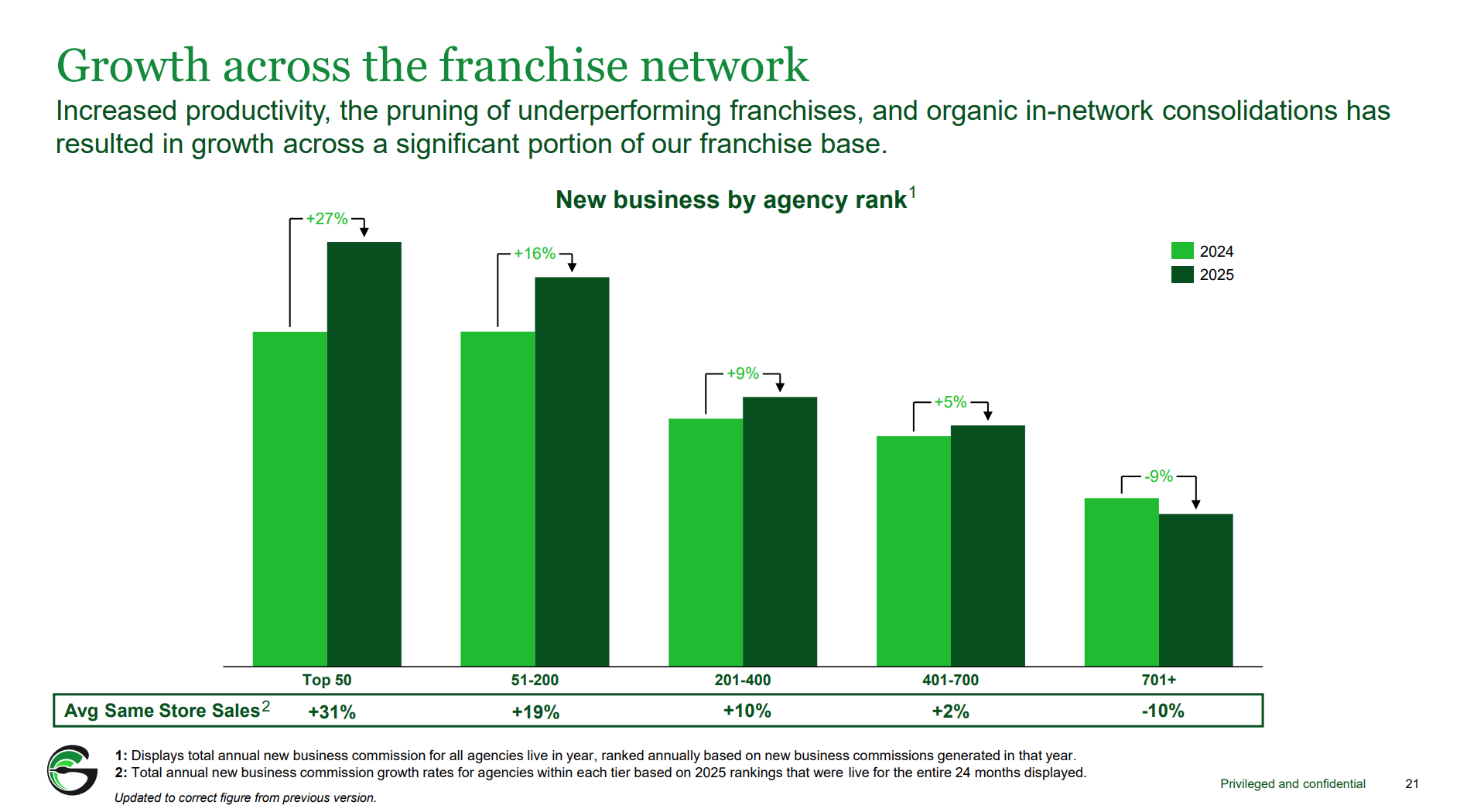
| The franchise channel experienced meaningful attrition for a few years after the COVID boom and is not a healthy sign for the trajectory of the business. | This assertion is grounded in analyzing total operating franchises, not franchise producers Franchise producers, and their productivity, is what matters; these drive PIF growth Franchise quality is improving, as is producers per franchise; adding a producer to existing franchise is more productive than that producer starting on their own Health of scaled agencies is strong; see SSS below |
Competition
- Primary channel and business model competition is Brightway (PE-backed) with ~$1.7B TWP and TWFG (Nasdaq:TWFG) with ~$1.8B TWP
- Both sell primarily personal lines and have franchise-like agency offerings, though they both sell a material amount of commercial insurance
- Both also use M&A as a material lever for growth
- Both Brightway and TWFG had about $900m TWP at the end of 2021, meaning they’ve grown TWP at approximately the same rate through today. Both grew TWP by a combined $1.7B from 2021 through 2025, whereas GSHD grew its TWP by $2.9B (from $1.56B to $4.45B) over the same period, roughly 1.7x the other two combined
- Brightway and TWFG used M&A to achieve this growth
- Confie/Alliant (PE-backed; Confie and Alliant came together via significant merger) which is about the same size as GSHD by TWP (~$4.5B), but it focuses primarily on higher risk auto / specific demographics and does not focus on HO; it also deploys a heavy M&A growth strategy
- Confie/Alliant grew its TWP by $2.2B from 2021 to 2025. GSHD’s growth of $2.9B outpaced Confie’s growth at 1.3x. Confie/Alliant used M&A to achieve this growth
- Other independent agencies that primarily sell commercial insurance but also sell personal lines, such as FirstChoice (MarshBerry), Baldwin (Nasdaq:BWIN), Hub International (PE-backed), USI (PE-backed)
- Independently-owned agencies, including those associated with network alliances like SIAA
- Carriers writing direct insurance, primarily Progressive and GEICO (though these carriers also embrace independent channel and are GSHD carrier partners)
- Captive carriers (State Farm, Allstate, Farmers)
Governance and capital allocation
- Up-C structure. Class A shares are the public entity’s shares, Class B shares are voting-only shares that track the LLC units held by the LLC members. A + B = Total Economic Value = Total LLC Units.
- Founders hold ~33% of the stock. They have sold down from ~75% ownership immediately after the IPO in mid-2018. I view this as a wealth diversification event at prices that seem to have been above intrinsic value for most of the company’s public history. Founding couple (Mark and Robyn Jones) are on the board. Mark Jones is Executive Chairman
- Founders’ son, Mark Jones Jr., is now President and COO (May 2026) after having been CFO and rising roles before that. In my view, he will transition to CEO in the next few years (if not sooner) and remain in this role for the long-term
- Mark Jones Jr. has been around the business virtually his whole life; he started learning the business at the dinner table
- Potentially an indirect skin-in-the-game dynamic carrying on family legacy and as a beneficiary for future inheritance tied to GSHD equity
- Company has returned cash to shareholders primarily via special dividends; aggregate of $292m since April 2019
- $15m (Apr 2019)
- $42m (Aug 2020)
- $60m (Aug 2021)
- $175m (Jan 2025)
- Share repurchase activity started in 2024 and continued through Q1 2026 (increased program to $198m on 2/17/26); total of $195m in last two years retiring ~3.0m shares (puts total shares back to about the IPO share count in mid-2018, so they have effectively now offset all SBC dilution since going public)
- 2024 (FY): $63m at ~$60/share
- Q3 2025: $59m at ~$86/share
- Q4 2025: $23m at ~$70/share
- Q1 2026: $50m at ~$51/share
- Recent Insider activity
- CEO Mark Miller and President/COO Mark Jones Jr. bought a combined $285k at ~$37/share in mid-May
- New GC bought $200k at $42/share in mid-May
- New CFO bought $175k and former Chief Legal Officer (founders’ son-in-law) bought $100k at ~$35/share at end of May
- Despite the stock price pressure, the founders’ trust has been selling shares. About $9 million has been sold since the beginning of May; this is a small portion of their overall holdings – about 220k shares on total holdings of over 12m
- CEO Miller ($360k) and COO Jones Jr. ($65k) bought in the low $70s/share in October/November 2025
- Company has debt, primarily to fund dividends (and more recently the buyback); stated target of 3-4x EBITDA, currently 2.4x net leverage on LTM Adjusted EBITDA (SBC added back)
- I would prefer <2x with a 3x ceiling for flexibility on share buybacks and sound-sleep conservatism on debt service
- With the recent stock dislocation, management drew on the revolver to buy back shares (they did not directly say this but it is evident with the most recent quarter). I suspect that they would have preferred being less levered when this buyback opportunity came along
- Company has paid down debt on a discretionary basis twice
- Management compensation
- Annual cash bonus tied to revenue/expense relative growth and Adjusted EBITA before contingent commissions
- Long-term incentive is stock options struck at 10% above grant date stock price, 3-year vest
- Company states it does not allow repricing of stock options or buyout of underwater stock options
- Up-C structure comes with a Tax Receivable Agreement (TRA) where the public entity shares in 15% of the tax benefits from the structure. Cash tax modeling considers TRA payments
Valuation
The core engine driving growth at GSHD is PIF and TWP growth. Revenue follows TWP growth, and with margin expansion from operating leverage and the growing higher-margin renewal book, free cash flow growth will outpace revenue growth.
Most of the rigor in the valuation approach and modeling was in breaking down revenue within each business segment by the core drivers of PIF growth. These are 1) number of selling agents and 2) the productivity per selling agent in policies sold per working day. Less rigor was applied to breaking down operating expenses, with the tradeoff of looking at several operating leverage cases.
The key insight from this exercise was that the renewal book mechanics, mostly the franchise royalty renewal royalty step up, drives a mechanical annual revenue growth of about 12-13% on average in the next five years and 7-10% thereafter. This remains true with 0% growth in agent headcount. This is because new business written from last year, with the royalty step-up, becomes this year’s incremental renewal book revenue which remains well ahead of this year’s renewal book churn.
With modest agent growth and productivity growth, the base case model produces annual revenue growth in the mid-teens, which coupled with margin expansion, should mean free cash flow growth approaching 20%.
I estimate fair value to be in the $80-$100 per share range at an 11-12% discount rate.
The double-digit revenue growth mechanism
First, an important distinction in what I’m claiming the market recognizes about GSHD.
The market must recognize the qualitative benefits of the renewal economics of an insurance agency book of business. This was previously reflected in the stock price and valuation. Management has talked frequently about the referral economics.
What I’m claiming is that the market is not currently recognizing and ascribing appropriate value to the base case scenario, which derives double-digit revenue growth from a reliable renewal book mechanic. In other words, the market is not appropriately pricing the combination of the likelihood and magnitude of this base case.
The current reality is that GSHD’s corporate and franchise new business capacity far outpaces the churn on each of those books. A simple way of looking at this is the cushion for “treading water.” For example, the franchise premium book is $3.7B, and at 90% dollar retention, $370m falls away. New business must replace this exactly to tread water. In 2025, I estimate franchise new business premium was $1.1B. This is 2.95x the treading water amount. For the corporate book, it’s 2.5x. We are far from the treading water mark on either book.
Cut another way, Franchise productivity could fall 88% in 2026 to hold revenue flat, while Corporate productivity could fall 19% to hold revenue flat. Franchise is more pronounced given the royalty step up, but it is 80% of GSHD’s overall premium book. It is the engine carrying most of the weight.
But new business premium is not stalling, it is growing. New business premium growth is a function of productive capacity growth (growth in the number of producers) and per producer productivity (growth in the number of policies and/or premium sold per producer).
At Corporate, all growth has come from an increase in productive capacity as productivity has waned in the last two years. I attribute this primarily to the tail end of the hard market and also due to new hires in the Enterprise sales team. On Enterprise, I suspect there’s an increasingly material conflation in the implied productivity metrics because Enterprise agents are in the Corporate sales headcount but some Enterprise deals are struck as new franchise partners, which would show up in the Franchise segment. Corporate new business commissions have grown 9% annually the last couple of years while headcount has grown 28% (including Enterprise agents). (An aside, I would ask about this reporting wrinkle if in contact with management).
At Franchise, growth has come from a combination of productive capacity (4% annually last two years) and productivity (new business royalty fees up 14% annually last two years including the effect of productive capacity).
Despite the persistent hard market, new business premiums have been growing off of a base that is already at least 2.5x of the treading water amount.
Another important assumption is the premium dollar retention. It is a function of client retention and rate growth. Client retention dips in hard markets – people get dissatisfied and shop when their rates go up, regardless of whether they have access to choice (people shop more often than they actually switch). In soft markets, client retention tends to increase.
GSHD’s client retention in a soft market was 87%-88% (2016 through 2020), which they claimed was near the top of the industry. In the next 5 years, which are expected to reflect a soft market, I think the 87% to 88% client retention mark is again achievable. Layering on 4-5% rate growth – GSHD is more exposed to HO than auto, and HO rate should grow above inflation as discussed previously – a premium retention of over 90% is a reasonable base case.
At 90% retention, what would need to happen for GSHD to generate double-digit revenue growth? They would have to keep new business production flat – meaning no new productive capacity or productivity enhancement.
The values in the table below at a 90%+ retention rate are all green – representing double digit revenue growth. The analysis is based on a simple forecast of the next 5 years based on actual historical data – separate from the valuation model.
| Premium Retention \ NB Prem Growth | 0% | 5% | 10% | 15% |
|---|---|---|---|---|
| 80.0% | 3.7% | 6.2% | 8.9% | 11.7% |
| 82.5% | 5.4% | 7.9% | 10.5% | 13.2% |
| 85.0% | 7.1% | 9.5% | 12.1% | 14.7% |
| 87.5% | 8.9% | 11.2% | 13.7% | 16.3% |
| 90.0% | 10.7% | 13.0% | 15.4% | 17.9% |
| 92.5% | 12.6% | 14.8% | 17.1% | 19.6% |
| 95.0% | 14.4% | 16.6% | 18.9% | 21.3% |
I expect new business premium growth of 10%+ to be a likely scenario over the next 5 years given the focus on producer growth within the franchise system and the renewed focus on growth at Corporate. Corporate has opened 4 new offices so far in 2026 alone. The 10% is achieved through both headcount growth and productivity growth.
The Franchise Agreement has a minimum growth expectation for new business, putting a franchise in default of the agreement if the threshold is not met. The actual threshold seems to be set in the Brand Standards manual, but the Agreement states a cap of 10%. If a default mechanism is set to a hefty portion of that 10% cap, I’d conclude that 10% new business growth is not a strenuous hurdle, particularly if an agency is hiring new producers every year.
In Q1 2026, Corporate sales agent headcount grew 13%, with productivity up 11%, still in a relatively hard market. Most of the Corporate hiring happens in Q2 and Q3. Franchise headcount grew 3%. Blended, Q1 headcount growth was 4%. Productivity was up 29% in Franchise (per franchise productivity).
Soft market conditions should be a sizable, additional tailwind on productivity.
Notes on Model and Base Case:
- EBIT margin expansion in the magnitude of hundreds of basis points is not unprecedented, albeit on a lower base to date; excluding contingent commissions, core EBIT margin troughed at breakeven in 2021, when the corporate sales agent headcount reached its peak. It has climbed every year since then, to 11% in 2025
- Base case assumes 65 bps of contingent commissions as a percentage of TWP. Management’s long-term expectation is 80 bps
- EBITDA and Unlevered FCF is burdened for stock-based compensation (SBC)
The Base Case implies a 9% written premium share for GSHD in 2040 in the Independent Agency channel, and less than 4% of industry premium overall. This significantly lags management’s expectation to become the “largest distributor of personal lines insurance in our founders’ lifetime,” as today’s largest underwriters have leading share of around 18%, which is a reasonable proxy for a distributor. Note that an IA distributes for multiple insurers, so share of a distributor is not mutually exclusive to the underlying premium share.
Discounted cash flow
In the Base Case, a 15% return is priced at $49, 40% upside to today’s price.
A WACC of 11% implies fair value of $97, nearly 3x upside in the Base case and ~9% upside in the Conservative case.
| Base | |||
|---|---|---|---|
| Discount | Share Price | Discount | Share Price |
| 9.0% | $153 | 12.5% | $73 |
| 9.5% | $135 | 13.0% | $66 |
| 10.0% | $120 | 13.5% | $61 |
| 10.5% | $108 | 14.0% | $56 |
| 11.0% | $97 | 14.5% | $52 |
| 11.5% | $88 | 15.0% | $48 |
| 12.0% | $80 | 15.5% | $44 |
| Conservative | ||
|---|---|---|
| Discount | Share Price | Upside* |
| 9.0% | $60 | 69% |
| 9.5% | $53 | 50% |
| 10.0% | $47 | 34% |
| 10.5% | $42 | 21% |
| 11.0% | $38 | 9% |
| 11.5% | $35 | (1%) |
| 12.0% | $32 | (10%) |
*From $35.13 per share
The Conservative Margin cases show value if EBIT margin stays flat at the 18.6% trough in 2026 for the entire 15-yr projection period. This still produces 65% upside from today’s price in the Base Case and downside of 20-30% in the doubly Conservative Case.
| Base - with Conservative Margin | |||
|---|---|---|---|
| Discount | Share Price | Discount | Share Price |
| 9.0% | $91 | 12.5% | $43 |
| 9.5% | $81 | 13.0% | $39 |
| 10.0% | $72 | 13.5% | $36 |
| 10.5% | $64 | 14.0% | $33 |
| 11.0% | $58 | 14.5% | $30 |
| 11.5% | $52 | 15.0% | $28 |
| 12.0% | $47 | 15.5% | $26 |
| Conservative - with Cons. Margin | ||
|---|---|---|
| Discount | Share Price | Upside* |
| 9.0% | $39 | 11% |
| 9.5% | $35 | (2%) |
| 10.0% | $31 | (12%) |
| 10.5% | $28 | (21%) |
| 11.0% | $25 | (29%) |
| 11.5% | $22 | (36%) |
| 12.0% | $20 | (42%) |
*From $35.13 per share
Relative valuation
Trading multiples of scaled but more mature insurance brokerage peers offer additional valuation context. These peers are more capital intensive than GSHD as M&A is a significant growth lever and its 100% corporate-owned agency model. The split between organic and M&A growth tends to be 50/50. Brown & Brown and AJ Gallagher are mid-teens topline growers while AON and Marsh are more like 10% topline growers. Of these brokerage peers, BRO and AJG are the closest comparables given the growth profiles.
Given GSHD’s rate of growth, growth that’s 100% organic, no OpEx burden from continuous M&A integration, and its capital-light franchisor business model, GSHD should command a premium multiple versus the brokerage peers, all else equal. Characteristics of personal lines may warrant a valuation discount to commercial, all else equal. However, GSHD’s margin and capital-light business model outweigh this consideration.
The scaled broker group (BRO, AJG, MRSH, AON) have historically traded in the 17x NTM EBIT area over the last 3 years (see below), save for the recent stock price pressure. GSHD traded at a significant premium, which is no longer the case. (The multiples in the chart below are directional and not precise. I don’t have 100% confidence in the precision of the data provider’s enterprise value calculation; that said, mid- to high-teens EBIT multiples is consistent with other sources).
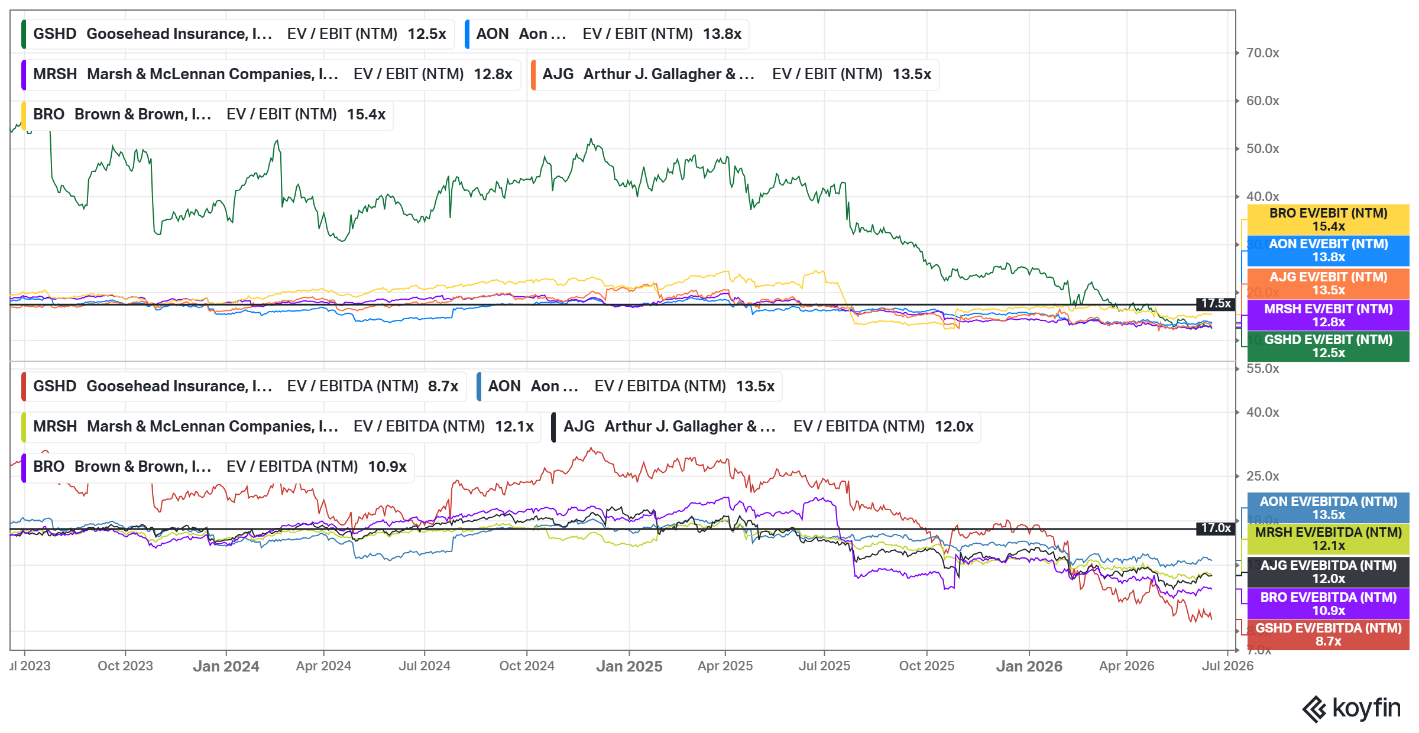
A simple, conservative future EBIT multiple valuation on the Base Case also produces a 3-Yr IRR of 22% with a 16x multiple, below the historical range of its peers which should trade at a discount to GSHD. A multiple of 20x NTM EBIT, reflecting a premium, implies a share price of $82. The IRRs shown are 3-year IRRs and are conservative – an NTM multiple on a 2029 metric produces a valuation at the end of 2028, which is less than two years from today, and future Net Debt gives no credit for cash generation.
US$ in millions.
Hypothesis monitorables (ranked by relative importance)
- PIF growth consistently above ~15%, which would mean high-teens premium growth, which translates into mid- to high-teens revenue growth
- Client retention climbing back up to high 80s, which would mean premium retention above 90%
- Stagnating client retention would signal something is not working with service or competitiveness of the carrier portfolio, particularly in a softening market
- Franchise producer growth and producers per franchise growth
- Operating franchises can decline if total franchise producers continue to grow
- Larger agencies are healthier for long-term growth and near-term productivity
- Per producer productivity by segment – Corporate, Franchise, Enterprise (not currently broken out)
- Base case requires 3% annual increase in productivity, business currently is double digits
- Overall GSHD commission rates holding or steadily increasing; avoiding commission compression caused by Direct channel share gains
- Thesis is that GSHD should continue to be insulated from commission compression
- Based on my conversations, GSHD commands among the highest rates of all IA partners with its carriers
- Soft market should be a tailwind for commissions as carriers try to compete in placing their product
- In the recent hard market – a particularly long and harsh one – GSHD held its NB commission rate steady at 14-15% and its renewal commission came down gradually from a peak of 14% to 12% in 2025. This is likely more of a result of a hard market than any structural headwind
- Continued focus on the IA channel by the largest Direct carriers like Progressive and GEICO would be supportive of the thesis
- Operating leverage in headcount and G&A lines would coincide with positive sales productivity and effective use of AI and technology in the service function. Near term G&A could be burdened by technology investment and this is anticipated in the Base Case
- How is consumer behavior around the HO buying experience changing and not changing?
- Given their recent challenges with local business and agent structure, how is State Farm’s market share, particularly in HO, evolving?
- How is the Enterprise business evolving?
- What specific ways is GSHD improving its technology? What is increasingly proprietary, if anything?
- Management has been steadfast in opposing national marketing and turning on the franchisee ad fund; is this a missed, high-ROI opportunity? At what level of market share nationwide would it make sense?